
Walking in Resilience: Rising After Setbacks and Disappointment
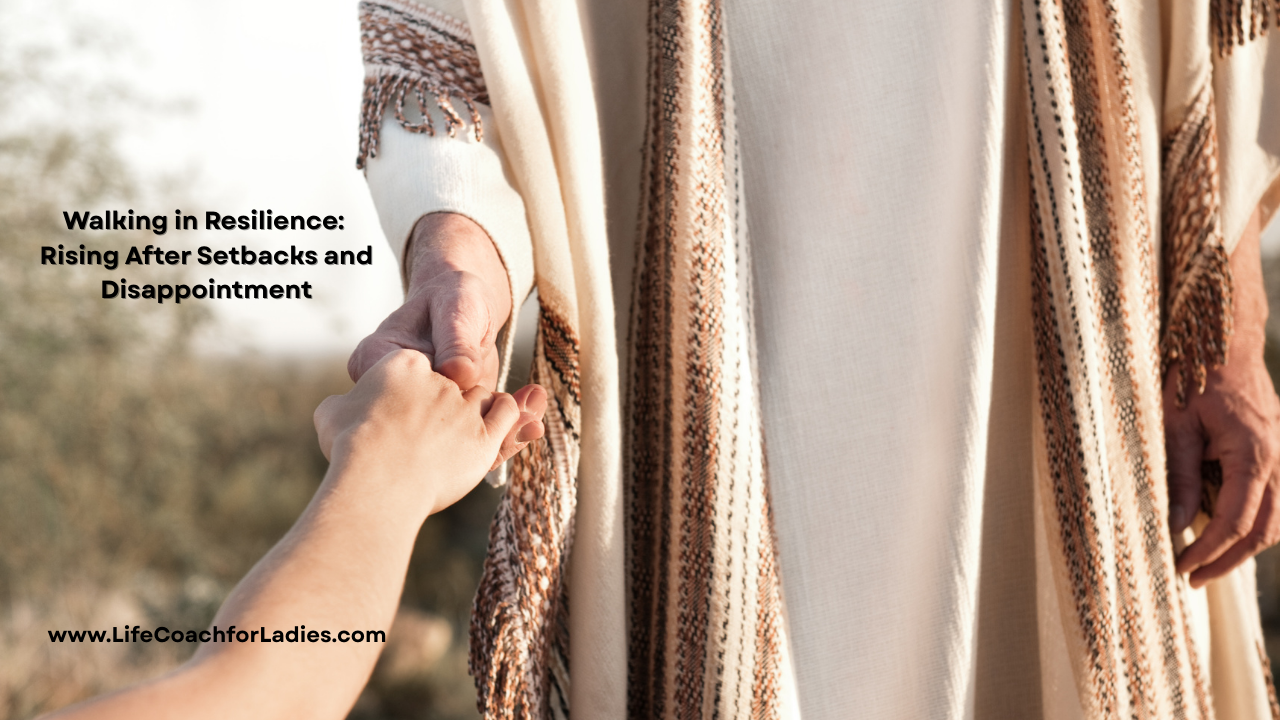
When the Wind Knocks You Down
Setbacks rarely announce themselves. They arrive as unexpected news, delayed answers, closed doors, or quiet disappointments that linger longer than anticipated. Faithful Christian women often internalize these moments, wondering what went wrong or what they missed.
Resilience is not the ability to avoid falling. It is the willingness to rise again—grounded in truth rather than shame.
God does not abandon His daughters in disappointment. He strengthens them to walk in resilience, lifting their gaze from what was lost to what He is still building.
The Lie We Often Walk With (Lie-Locked Living)
The Lie: If I were truly faithful, I would not experience setbacks like this.
This lie turns disappointment into self-accusation. It suggests that difficulty indicates disfavor rather than development.
Lie-Locked Living shows up as discouragement, withdrawal, comparison, and the temptation to stop trying after a fall.
Scripture presents setbacks not as proof of failure, but as places where God refines perseverance and trust.
Scripture Anchor (KJV)
“Rejoice not against me, O mine enemy: when I fall, I shall arise.” — Micah 7:8 (KJV)
God’s promise is not the absence of falls, but the certainty of rising.
Biblical Story: Peter’s Failure and Restoration
Peter’s denial of Jesus was public, painful, and deeply personal. He had promised faithfulness—and then failed.
“And Peter went out, and wept bitterly.” — Matthew 26:75 (KJV)
Yet Jesus did not discard Peter. After the resurrection, Jesus restored him with purpose and recommissioned him with trust.
Resilience is formed when grace meets repentance and calls us forward.
The Truth Mindset™ Framework: From Defeat to Renewal
Target the Lie (Awareness): Believing setbacks disqualify calling
Replace with Scripture (Anchor): God restores and strengthens the fallen
Understand Its Meaning (Alignment): Failure is an event, not an identity
Turn It into a Declaration (Activation): I rise by God’s grace and continue forward
Hold It in Prayer (Abide): God restores my confidence and direction
Resilience grows where grace reshapes identity.
Science That Supports the Truth
Psychological research on resilience shows that recovery is strengthened by meaning-making—interpreting setbacks as temporary and instructive rather than permanent and personal.
God’s Word affirms this:
“Though he fall, he shall not be utterly cast down: for the LORD upholdeth him with his hand.” — Psalm 37:24 (KJV)
God upholds even in the fall.
Coaching Insight: Why Setbacks Feel So Personal
Coaching reveals that women often attach setbacks to self-worth. When outcomes disappoint, identity is questioned.
Walking in resilience means separating what happened from who you are.
God restores identity before He redirects steps.
Tools & Strategies to Walk It Out
-
Name the disappointment honestly without self-blame
-
Identify what remains true despite the setback
-
Choose one faithful action to re-engage
-
Invite God into the rebuilding process
Assessment Insight: Personality and Recovery
Some personalities rebound quickly; others process deeply before moving forward. Understanding personal wiring helps women recover with compassion rather than pressure.
God restores at a pace that heals, not harms.
Modern-Day Coaching Example
A woman once said, “I thought that failure defined me.” Through coaching, she learned to view the setback as a chapter, not the whole story.
When she chose to rise again, confidence returned gradually but firmly.
Perspective Quote
“Courage does not always roar. Sometimes courage is the quiet voice at the end of the day saying, ‘I will try again tomorrow.’” — Mary Anne Radmacher
Truth Declaration
I walk in resilience, rising after setbacks by God’s grace. I am not defined by failure but by faithfulness and restoration.
Gentle Coaching Reflection
-
What setback has been weighing on your heart?
-
How might God be inviting you to rise rather than retreat?
-
What next step could restore momentum with grace?
Closing Encouragement: Rise and Walk On
God does not waste disappointment. He redeems it.
As you walk in resilience, remember that falling is not the end of your story. By God’s hand, you will rise and continue forward.
“Strength and honour are her clothing; and she shall rejoice in time to come.” — Proverbs 31:25 (KJV)
Stay connected with news and updates!
Join our mailing list. You can download a free gift and receive the latest news and updates from our team.
Don't worry, your information will not be shared.
Recent Posts
Author

Coach Sandra
Author
At Life Coach for Ladies, we understand your desire for a life that is truly significant—a life that matters. To achieve this, it is essential to step into the purpose for which you were created. However, the world often misleads us with false notions of significance, making us feel less worthy than we truly are. We believe that God has intricately designed each of us for a unique purpose in His Kingdom. He crafts us with intention, uniquely shaping us for His plans. That is why we help women to recognize their significance in God’s Kingdom and cultivate a Truth Mindset. Here’s how we do it: 1. Embrace your true identity as a ‘daughter of the King.’ 2. Discover the unique gifts that the Holy Spirit has specifically and strategically given you. 3. Learn to walk intentionally in those gifts and draw closer to Christ. Schedule a free Transformational Game Plan Session today. Meanwhile, download my free eBook to help you fill the void you might feel and start living with success, significance, and a meaningful legacy. Sandra Krug is a Board Certified Coach (BCC) through the Center for Credentialing and Education. Coach Sandra is a Certified Master Christian Life Coach (CMCLC) through the International Christian Coaching Institute, with Certification as a Transformed Living Coaching Model Specialist and a Spiritual Transformation and Discipleship Niche Specialist. She is a Certified and Licensed Ziglar Choose to Win and See You at the Top Coach. (Ziglar is a name that has been synonymous with integrity and success for over 50 years.) She is a Certified Disc Profile Analyst and a Certified Human Behavior Consultant through Personality Insights. She is also a Certified Christian DISC Facilitator. Coach Sandra has an Advanced Diploma in Biblical Studies from the International School of Ministry and a Master's in Ministry from Christian Leadership University. She also received an Honorary Doctor of Divinity in Business and Ministry from Vision International. Her Christian values are fundamental to her life and coaching ministry. She resides in Florida with her husband, Garrett, and their ranch of rescued animals.
Stay connected with news and updates!

